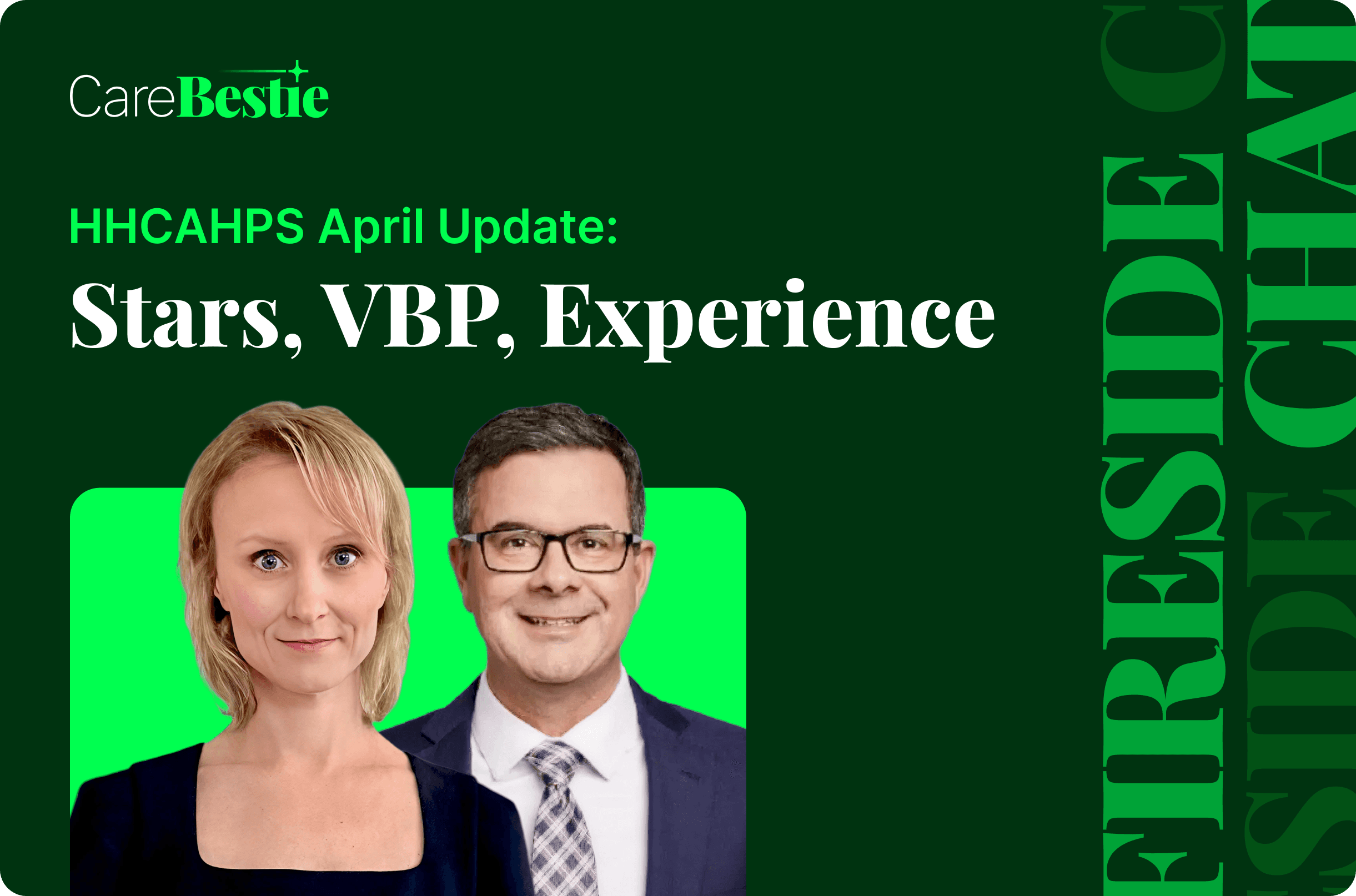
Fireside chat
by
CareBestie
A conversation with Nina Del Grande, Director of Quality at Addus
Patient satisfaction in home health has never been more consequential. Star ratings are public. Reimbursement is tied to scores. And in most markets, dozens of agencies are competing for the same patient populations. Yet the national HCAHPS survey return rate hovers around 30% - meaning the majority of patients never have their voice counted at all.
In a recent fireside chat, Nina Del Grande, Director of Quality at Addus - one of the largest home health, hospice, and personal care providers in the country - sat down to talk about where agencies struggle, what actually moves the needle, and what she's learning from its pilot with CareBestie.
Watch the full conversation here:
The Real Reason Patient Satisfaction Falls Through the Cracks
Ask most agency leaders why their HCAHPS scores aren't where they want them to be and you'll hear about survey methodology, lag time, or patient demographics. Nina points to something more fundamental: consistency.
"Staff are busy. They're constantly being pushed to do more, admit more patients. And customer service sometimes falls by the wayside when you get busy."
The survey doesn't fail because patients don't care. It fails because the touchpoints that build patient awareness - explaining the survey on admission, reinforcing it throughout the episode, making patients feel that their opinion matters - require repetition that is very hard to sustain manually at scale.
"It has to be a priority," Nina says. "Just like your budget has to be a priority, your finances, providing quality care - your customer service has to be a pillar that you focus on. And when we lose that focus, it falls through the cracks."
The Survey Itself Is Only Part of the Problem
One of the more nuanced points Nina raises is about perception versus reality. Clinicians often deliver excellent care - they set up the home safely, they explain medications, they do everything right. But if they don't use the specific keywords and phrases the survey is designed to recognize, patients don't register it.
"I have seen clinicians do it on a home visit," Nina explains. "But if you don't use the keywords and phrases, patients don't know that's what you're doing. It's all patient perception - it's what the patient perceived you did."
This is a critical and underappreciated gap. The quality of care and the patient's experience of that care are not always the same thing - and survey scores reflect the latter. Closing that gap requires not just clinical competence, but consistent, intentional communication throughout every visit.
What Actually Moves the Needle
At Addus, Nina's team has built a layered approach to patient engagement that starts at admission and runs through discharge:
A welcome letter that explains the survey, shows the envelope patients will receive, and sets expectations from day one
Scripted keywords and phrases for clinicians to use on every visit
Welcome calls from office staff at defined touch points throughout the episode
A personal thank-you letter sent to every patient after admission, with the direct contact information for their clinical manager
That last element has had an outsized impact. "We've actually had patients write thank-you letters back for the thank-you card," Nina says. In a world where patients often navigate large agencies through phone trees and automated menus, a direct line to a real person signals something important: that they matter.
The Data Lag Problem - And Why Real-Time Feedback Changes Everything
Even agencies doing everything right face a structural challenge: the feedback loop is broken. CMS data can lag by six months to a year, making it nearly impossible to course-correct in real time.
"Clinicians want instant feedback," Nina says. "They want to know - how am I doing? What did my patient say? And I'm like, well, if I want to look at the data from CMS, I'll tell you in six months."
This is one of the core problems CareBestie was built to solve. Rather than waiting for a survey to arrive weeks after discharge, CareBestie's AI agent Michael reaches out to patients throughout the episode - after visits, during transitions, at key clinical moments - and surfaces issues in real time, before they become complaints, hospitalizations, or low scores.
What Addus Is Learning From Its CareBestie Pilot
Addus began piloting CareBestie in one of its larger branches, with a single small team. Even at that limited scale, the results have been immediate and revealing.
Patients love it - including the ones who said they wouldn't.
"Our patients that are using it love it," Nina says. The connectivity rate started around 50% and has climbed into the high seventies. More striking is what happened with one patient who was explicitly resistant to AI before admission. After her nurse walked her through the CareBestie experience, she had a warm, easy conversation with Michael and became one of the platform's most enthusiastic users.
"She just thinks it's the best thing since sliced bread."
Hidden operational problems surfaced immediately.
Scheduling gaps, communication breakdowns, supply issues - the team knew these existed, but not how pervasive they were. "I don't think we realized the severity of those issues," Nina says, "and they came to the forefront immediately. So we were able to start working on those."
Addus built an internal standard around the platform: any alert that comes in must be addressed within one hour. That operational discipline - a direct response to what CareBestie was surfacing - is itself a meaningful shift.
Symptom reporting is catching clinical risk early.
Patients are self-reporting things they might otherwise have dismissed: a wound vac beeping a little more than usual, slight weight gain in a heart failure patient, mild shortness of breath. These are precisely the early signals that, if missed, lead to preventable hospitalizations.
"Even that symptom reporting - it flags us, and we can at least make that call and then make that determination. Do we need to go see you today?"
Michael handles the hard conversations - and that makes everything easier.
One of the more unexpected benefits has been how CareBestie handles patient frustration. When a patient is upset, Michael listens calmly, without defensiveness, and works through the concern with genuine patience. By the time a human staff member follows up, the situation has already de-escalated.
"It's almost like Michael's taken the brunt of it," Nina says. "And now we're there to swoop in and be the saviors."
Where the Industry Is Headed
The home health industry is becoming more consumer-driven, more competitive, and more accountable. Star ratings are public. Value-based purchasing ties reimbursement to outcomes. And patients - even older patients who were assumed to be resistant to technology - are increasingly expecting the kind of responsive, personalized experience they get in other parts of their lives.
The agencies that win in this environment won't just be the ones with the best clinicians. They'll be the ones who make patients feel heard throughout their entire episode of care - not just when a survey arrives in the mail six weeks after discharge.
Nina's closing thought captures it simply:
"Overall, where we are in our journey so far - it's been a positive experience, and we're continuing to implement things."
That's what meaningful adoption looks like. Not a pilot that proves a point and gets shelved. A platform that surfaces real problems, changes how a team operates, and keeps getting built on.
Watch the fireside conversation here: